Iran’s Revolutionary Regime Heading Toward Collapse―— Israel and the Trump Administration Hold the Key —
By Ikuzo Kobayashi, President of the NPO Salaam Association
From the Winter Issue of the electronic “Salaam Quarterly Bulletin”, No.56, Feb 2026
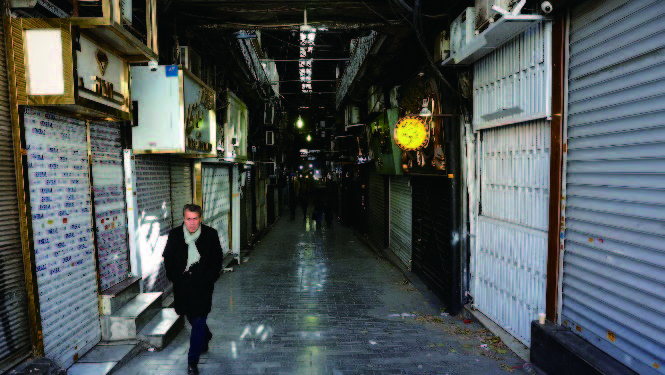
Shops closed in protest at the Grand Bazaar in Tehran, hotographed on December 30, 2025. Photo: Majid Asgaripour / WANA (West Asia News Agency) via REUTERS (Updated January 3, 2026, 4:43 a.m. GMT+9)
On December 28 last year, Tehran’s Grand Bazaar closed en masse in protest. The reason was soaring food prices caused by financial hardship resulting from the collapse of Iran’s currency under U.S. economic sanctions, particularly restrictions on oil exports. The impact reached even the merchant class, which had traditionally supported the religious regime.
Protests that began among the poor quickly spread to students, workers, merchants, and eventually to public-sector employees such as teachers and nurses. Within the first few days of the new year, large-scale demonstrations occurred not only in major cities but also in provincial towns, reportedly involving several hundred thousand people in total.
The protest movement at the end of 2017 carried the slogan “Bread, Jobs, and Freedom,” but did not include bazaar merchants and subsided within two weeks. In 2019, gasoline prices suddenly rose by 50 percent, and a tiered system was introduced: up to 60 liters per month at the standard price, and above that at triple the price. Some demonstrators clashed with security forces. Iran, a major oil producer, had maintained one of the world’s lowest gasoline prices, but sanctions imposed after the first Trump administration withdrew from the nuclear deal placed severe strain on the Iranian economy.
From 2022 to 2023, protests under the slogan “Women, Life, Freedom,” sparked by the death of Kurdish woman Mahsa Amini, developed into opposition involving more than 80 percent of society and had wide social impact. However, they did not become a movement capable of overthrowing the regime.
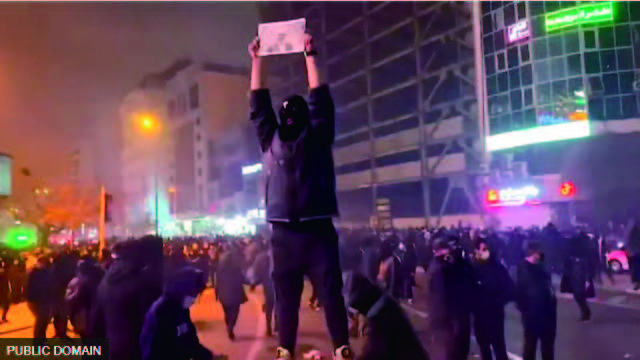
Protest at Karaj Square in northwestern Tehran. One demonstrator holds a photo of Reza Pahlavi, son of the former Shah who was ousted in the 1979 Islamic Revolution and now lives in the United States. (Photo caption: BBC News Japan, January 13, 2026)
2024: A Weakened Iranian Revolutionary Regime
1)Loss of Hezbollah and the IRGC Quds Force in Syria
In April 2024, Israel carried out a pinpoint airstrike on the Iranian consulate building adjacent to Iran’s embassy in Syria. Brigadier General Zahedi, head of overseas operations of the IRGC Quds Force, and five other senior officers were killed. Zahedi had commanded Shiite militias in Syria.
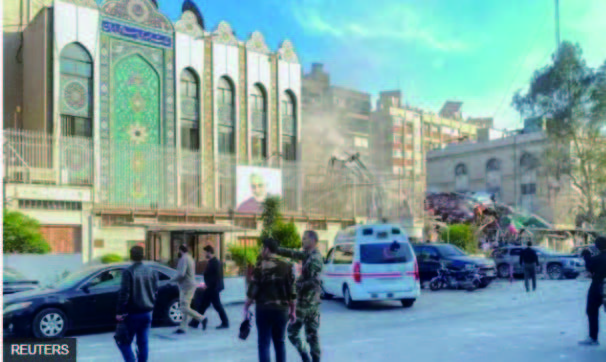
Screenshot from a BBC News Japan video (April 2, 2024), “ Iranian Consulate in Syria Hit by Airstrike: Many Senior Military Officials Killed amid scalating Conflict.” “The neighboring Iranian embassy was not damaged.
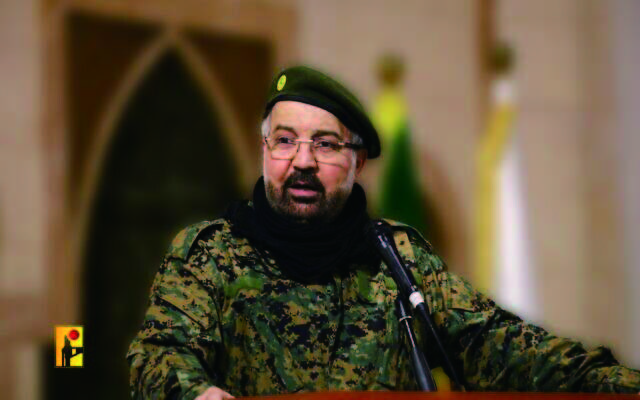
Fuad Shukr, senior commander of the IRGC Quds Force, was killed on July 30, 2024, in an IDF airstrike on his apartment building.
On the same day, July 30, the Israeli Defense Forces (IDF) bombed Beirut and killed Fuad Shukr, a senior Hezbollah leader and top IRGC Quds Force commander. Shukr had been a close adviser to Hassan Nasrallah and played a central role in the 1983 Beirut Marine barracks bombing that killed 241 U.S. soldiers.
Through the Gaza war, Iran lost Hezbollah—its most powerful proxy. Hezbollah, often described as the world’s strongest non-state armed group, operated independently of the Lebanese army and in line with Iran’s strategic intentions. It coordinated with Hamas and repeatedly attacked Israel after the Gaza war began.
Subsequent Israeli strikes devastated Hezbollah. On November 27, 2024, Israel and Lebanon agreed to a ceasefire. The agreement reflected Hezbollah’s crippling losses and Lebanon’s renewed ability to bring it under state control. Prime Minister Netanyahu declared that Israel had eliminated Nasrallah, destroyed most rockets and missiles, killed thousands of terrorists, and dismantled underground terror infrastructure along the border.
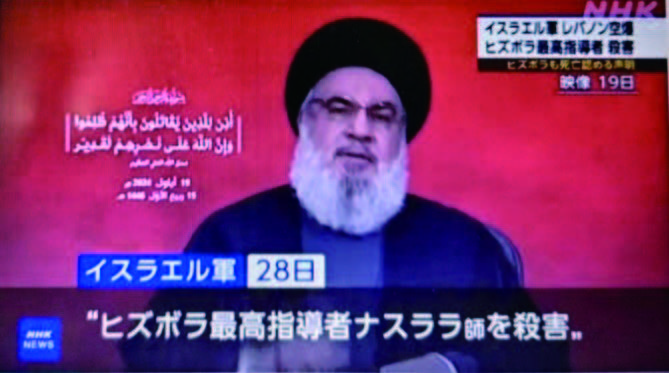
On September 26, 2024, Prime Minister Netanyahu ordered a missile strike on Hezbollah headquarters immediately after delivering a speech at the United Nations.
The missiles, believed to be bunker-buster bombs, struck Hezbollah’s underground headquarters in Beirut, killing Nasrallah and many senior Hezbollah leaders who were with him.
A cousin considered to be Nasrallah’ s successor was also killed.
2) Iran’s Air Defense Exposed
Following the deaths of Nasrallah and IRGC Quds Force commander Fuad Shukr, Iran entered a state of direct confrontation with Israel. On October 1, 2024, Iran launched 180 ballistic missiles toward Israel, reportedly including hypersonic missiles. With U.S. destroyers assisting in interception, major damage was avoided. President Biden stated that the attack had failed, while Prime Minister Netanyahu warned that Iran would pay a price.
On October 26, Israel retaliated with airstrikes involving 120 aircraft, targeting Iran’s Russian-made S-300 air defense systems, anti-aircraft guns, and missile fuel factories. All Israeli aircraft returned safely. Israel reportedly destroyed all three remaining S-300 systems. U.S. officials commented that Iran was now “essentially naked” and highly vulnerable to future airstrikes.
2025: Israel’s “Twelve-Day War” and America’s “Operation Midnight Hammer”
1) Israel’s Twelve-Day War
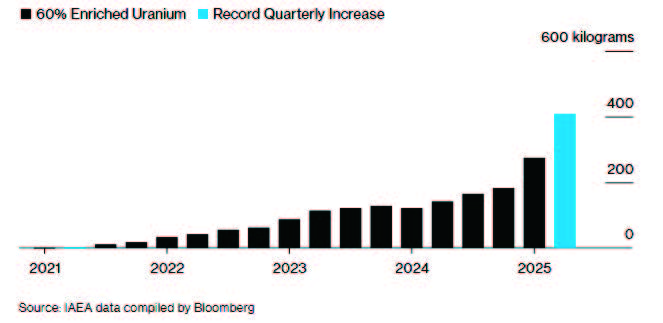
IAEA report showing the increase in Iran’ s stockpile of highly enriched uranium (Chart source: Bloomberg, June 1, 2025)
By late 2024, Hamas had been largely dismantled, leaving hostage negotiations as the remaining issue. Hezbollah, severely weakened, was forced under Lebanese army control. On January 13, 2025, with the appointment of Prime Minister Salam, Hezbollah lost political influence as well.
Syria’s interim President Sharaa remained under Israeli observation, but stabilization was expected to take several years.
In January 2025, the IAEA warned that Iran’s stockpile of highly enriched uranium had reached record levels. This violated the core red line of the nuclear deal, which Trump had cited as the reason for withdrawal. Trump pursued negotiations, but in May the IAEA reported that Iran had increased its stockpile by 50 percent in three months to 409kg—enough for approximately ten nuclear weapons if further enriched. Director General Grossi stated that the accumulation posed “serious concern” and that the IAEA could not guarantee that Iran’s program was peaceful.
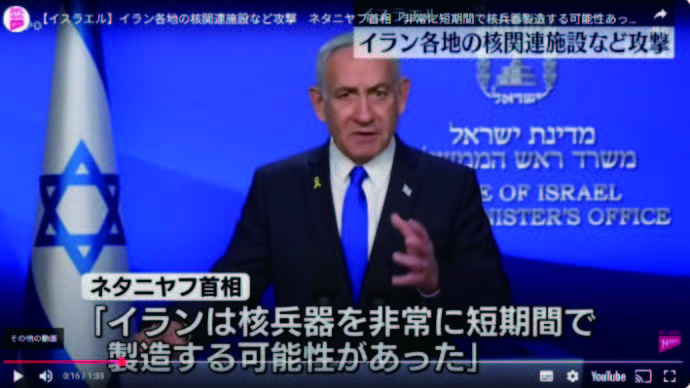
Screenshot from the NTV News YouTube channel
On June 13, 2025, Israel launched an operation named “Rising Lion.” Prime Minister Netanyahu stated that Iran posed a “clear and imminent threat to Israel’s very survival” and that the operation was intended “to protect neighboring Arab countries from Iranian aggression.”
Citing the right of self-defense and the IAEA report as justification, Israel undertook a preemptive strike against Iran under the banner of defending Gulf regional security. The objectives were the assassination of Iran’s top military and nuclear development officials and attacks on nuclear facilities.
Those targeted included Mohammad Bagheri, Chief of Staff of the Iranian Armed Forces, and Hossein Salami, Commander-in-Chief of the Islamic Revolutionary Guard Corps (IRGC). Salami, who was promoted in 2020 as the successor to former commander Qassem Soleimani, was known as a hardliner against Israel. Amir Ali Hajizadeh was commander of the IRGC Aerospace Force and is said to have directed missile attacks against Israel in April and October 2024.
In addition, Fereydoun Abbasi, a nuclear scientist who later became a member of parliament after serving as head of the Atomic Energy Organization of Iran, was a hardline proponent of Iran’s nuclear development program. Eight scientists were also killed.
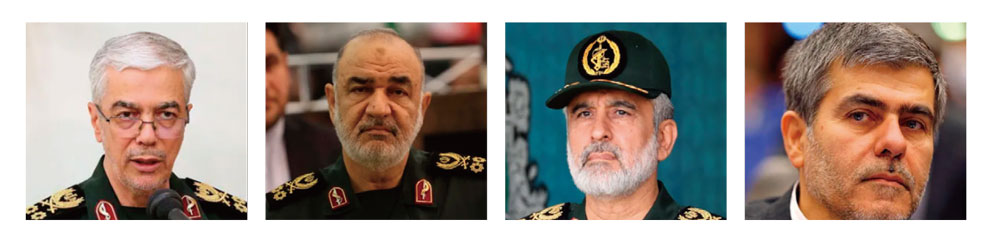
From left: Mohammad Bagheri, Chief of Staff of the Iranian Armed Forces;Hossein Salami, Commander-in-Chief of the Islamic Revolutionary Guard Corps (IRGC);Amir Ali Hajizadeh, Commander of the IRGC Aerospace Force;Fereydoun Abbasi, nuclear scientist (Photo: BBC News, June 14, 2025)
2) U.S. Operation “Midnight Hammer” (June 21, 2025)
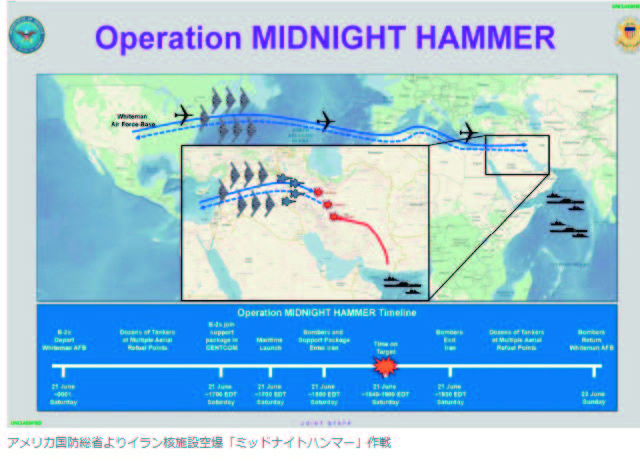
Image source: Yahoo! Japan News / Expert, June 23, 2025, 03:18
Iran should have accepted the nuclear agreement proposed by U.S. President Donald Trump and should have recognized his true intentions. Because the red line was defined by the United States, there was no legitimate basis for Iran to demand concessions from the American side. The Iranian revolutionary government misjudged the situation.
Operation “Midnight Hammer” was conducted on June 21 between 01:40 and 02:05 Iran time (07:40–08:05 Japan time on the same day).
During this 25-minute operation, fourteen of the world’s largest bunker-buster bombs (the underground-penetrating GBU-57)—twelve dropped on Fordow and two on Natanz—were released from seven B-2 stealth bombers.
The red marks on the map indicate, from top to bottom, the locations of the nuclear facilities at Fordow, Natanz, and Isfahan. It was announced that more than twenty Tomahawk cruise missiles were also launched at Isfahan from a nuclear-powered submarine in the Arabian Sea.
3) Trump’s 20-Point Gaza Peace Plan Adopted by the UN Security Council — Russia and China Abstained —
President Trump announced the “Comprehensive Plan for Ending the Gaza Conflict” (the 20-point peace plan) in September 2025. On October 13, 2025, Israel and Hamas reached basic agreement on the plan in Sharm El-Sheikh, eastern Egypt, through mediation by the United States, Egypt, Qatar, and Turkey. The agreement proceeded as a formal document entitled “Document on Peace in the Gaza Strip of the Palestinian Territories.” After the signing, President Trump stated,
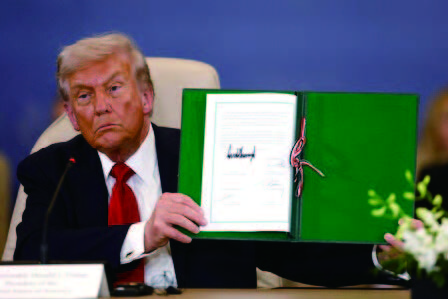
President Donald Trump
1, Immediate ceasefire and release of hostages;
2, Withdrawal of Israeli forces;
3, Removal of Hamas from governance (Hamas and related organizations are excluded from Gaza’s administration, military, and security);
4, Demilitarization (disarmament of Gaza, destruction of weapons production facilities, and neutralization of tunnels under third-party supervision);
5, Establishment of an interim governing framework under international supervision;
6, Protection of residents’ rights, including freedom of evacuation and return, and reconstruction with international assistance. At present, item 4 (demilitarization) is considered to be in progress
On November 17, 2025, the plan was adopted by the UN Security Council with 13 votes in favor and 2 abstentions and was approved as Resolution 2803.
Russia, which has close military ties with Iran, and China, which has close economic ties with Iran, abstained and did not use their veto power. This reflects the fact that they lack both the position and the influence to act as major players in Middle East peace. Meanwhile, Iran’s influence, which had been exerted openly and covertly until six months earlier, has largely disappeared. A new framework has been formed, centered on the United States and involving the mediating countries and more than twenty other nations, to support peace and postwar reconstruction.
Iran’s Future
Observing these developments, the Iranian people have realized that their regime is oppressive, unable to resolve economic hardship, and fixated on viewing America as the “Great Satan” and Israel as the “Little Satan”—an outlook detached from global reality.
Regime collapse always begins from within, and Iran will be no exception. The key external factor lies with President Trump. His faith and conviction in creating peace will guide his decisive choice of timing.
Archives
1. Nov. 2025 The New Rebirth of Syria Sets Sail
1. Aug. 2025 The Trump Administration and the Situation in the Middle East―Iran is weakening and complicating the regional order
1. May. 2025 Will peace in the Middle East progress with the Trump administration?
1. Feb. 2025 The Path of Construction that Begins with Overcoming the ‘War on Terrorism’ (Part 2)
1. Nov. 2024 The Path of Construction that Begins with Overcoming the ‘War on Terrorism’ (Part 1)
1. Aug. 2024 Kuwait seeks true peace
1. May. 2024 Sanriku Railway Forms Ties with Kuwait
1. Feb. 2024 Anti-Semitism fueled by radical Islam and leftist ideology
1. Oct. 2023 Massive “Hamas” Terrorism Not Good for Palestine
1. Aug. 2023 Approval of the UK’s TPP Membership and Six Eyes
1. May. 2023 Saudi-led Arab countries
1. Feb. 2023 Japan Earns Trust as a Peaceful Nation
1. Nov. 2022 Gulf States and Israel Looking for Peace
1. Aug. 2022 Former Prime MinisterShinzo Abe, who made Japan credible as a global peaceful nation.
1. May. 2022 Warfare in the New Era:Digital Strategies as Deterrence Enhancement
11. Feb. 2022 Deepening and Expanding the Japan-US Alliance is the Way to Overcome China’s Communist
11. Nov. 2021 Free and Open Indo-Pacific Initiative and Afghan Problems
11. Aug. 2021 Peace in the Middle East and Japan: On the Occasion of the 30th Anniversary of the Gulf War
11. May. 2021 “Free and Open Indo-Pacific” for which global support is expanding
11. Feb. 2021 Thorium Molten Salt Reactors That Open the Gate of the Second Atomic Energy Age
11. Nov. 2020 Seriousness of Pompeo’s View on China and Subsequent Policy
11. Aug. 2020 Japan to set sail for full-scale peace diplomacy to the Middle East (3)
11. May. 2020 Japan to set sail for full-scale peace diplomacy to the Middle East (2)
11. Mar. 2020 Japan to set sail for full-scale peace diplomacy to the Middle East (1)
11. Nov. 2019 e-sports featured as a cultural project in the National Sports Festival
11. Aug. 2019 Status of Crude Oil Prices
11. May. 2019 Polygamy debate in Egypt: Statement of Ahmed el-Tayeb, Grand Imam of al-Azhar, supreme authority of Sunni
11. Feb. 2019 Year 2018 turned out to be the first year of e-sports
11. Nov. 2018 Trends in world economy and crude oil price in a Goldilocks economy
11. Aug. 2018 Full-scale launch of the plan to make programming education for e.s. compulsory by 2020
11. May 2018 President el-Sisi’s achievements over the past four years and prospects for the next four years
11. Feb. 2018 ESports getting prevalent in the Middle East ― To be an official athletic event from 2022 Asian Games
11. Aug. 2017 Aggressiveness of Islam and Imam’s anti-terrorism declaration
11. May 2017 Countdown to the destruction of the Islamic State of Iraq and Syria (ISIS)
11. Feb. 2017 Trump administration’s policy toward the Middle East
11. Nov. 2016 25 years after the end of Gulf – “Meeting of supreme Islamic leaders”
11. Aug. 2016 Announcement of the construction plan of the bridge between Saudi Arabia and Egypt across the Red Sea
11. May 2016 Deepened international collaboration for destruction of ISIL: Desired outcome of G7 Summit
11. Feb. 2016 Saudi Arabia vs Iran, Crucial moment
11. Aug. 2015 The results of international encirclement against the militant group, the Islamic State and the future challenges
11. May 2015 The GCC DAYS IN JAPAN held in Tokyo April 22-24, 2015
11. Feb. 2015 The limitation of the Arab Spring ― Egypt and Tunisia after the Arab Spring
11. Nov. 2014 3 Months from the Islamic State Shock – Change of US Strategy for Air-Strikes and Encirclement
11. Aug. 2014 High expectation for Egypt’s el-Sisi administration’s efforts in mediating ceasefire
11. May 2014 Kuwait’s enthusiastic assistance for recovery from Great East Japan Earthquakes
11. Feb. 2014 Roadmap to Democratization of Egypt
11. Nov. 2013 Era in which “Live Healthy” is contribution to the society
11. Aug. 2013 Public speech of Ms. Sara Akbar
11. May 2013 Merits and demerits of the US-Iraq War
11. Feb. 2013 Expectation for Prime Minister Abe to implement the best energy policy